

7 THINGS I LEARNED FROM WILL SHORTZ

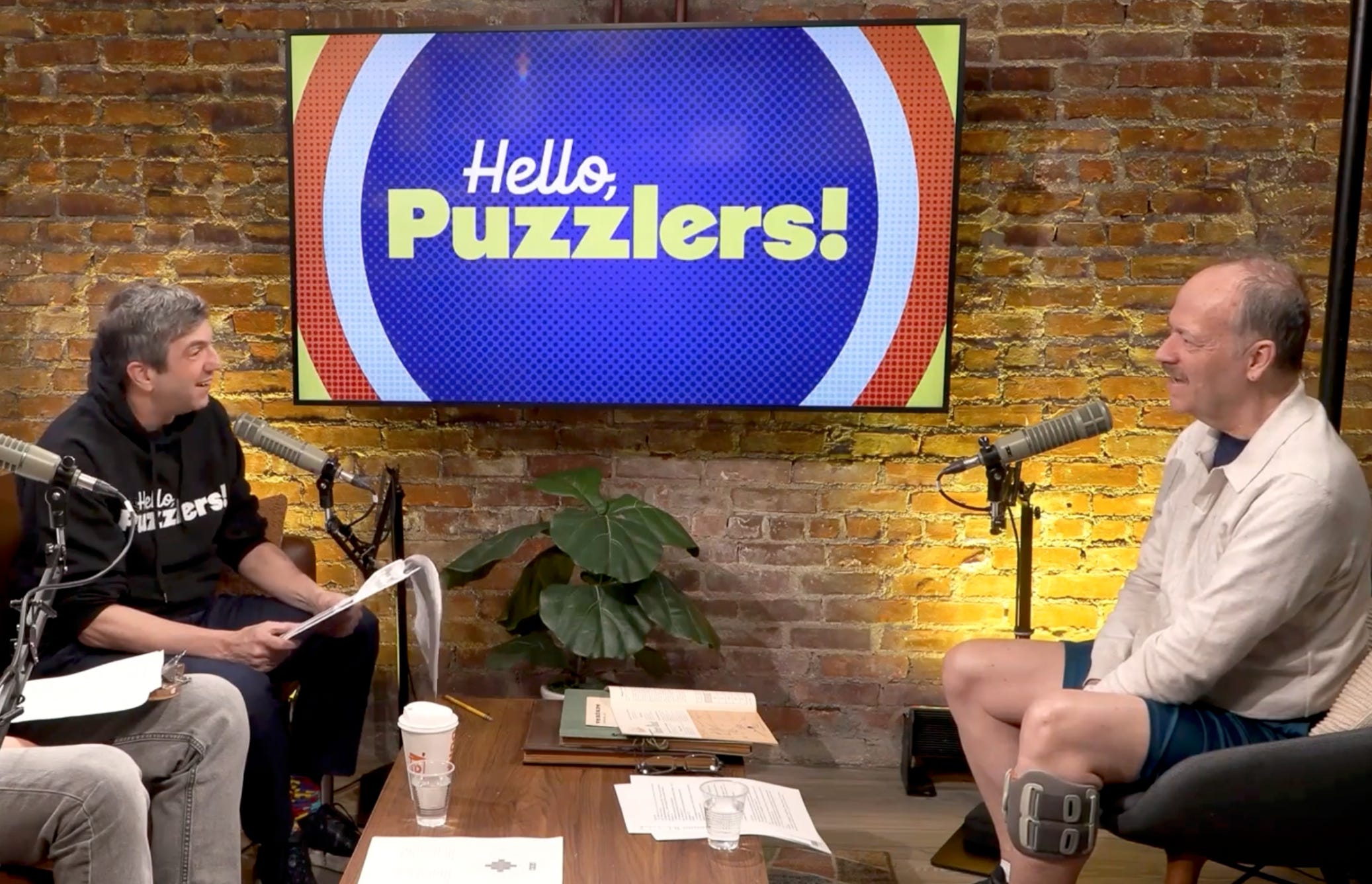
We’ve recorded 623 episodes of my podcast Hello, Puzzlers! – but we just released a very, very special episode (yes, two very’s!).
It’s with the Papa Bear of Puzzling himself, Will Shortz.
As you may know, Will is the crossword editor of the New York Times, the NPR Puzzle Master, and author or editor of 775(!) books.
I interviewed Will a few weeks ago near his house in Westchester, New York, alongside my partner in puzzle podcasting Greg Pliska.
It was one of my favorite interviews ever.
Greg and I interviewed Will about his life in puzzles and how we’re in the Golden Age of Puzzling. The interview also got surprisingly personal. At times, I felt like Barbara Walters. We delved into Will’s later-in-life marriage, his debilitating stroke and ongoing recovery, and his philosophy of life. Of course, we also gave him word puzzles, and vice versa.
The show is available in audio and on video on YouTube. We’re really proud of it, and hope you like it as much as we do.
To whet your appetite, I’m extracting just seven of the nuggets of wisdom I learned from Will. What struck me wasn’t merely Will’s puzzle knowledge. It was that his approach to puzzles turns out to be a surprisingly good approach to life.
1. PUZZLES FOSTER CURIOSITY, AND CURIOSITY IS GOOD FOR HUMANITY
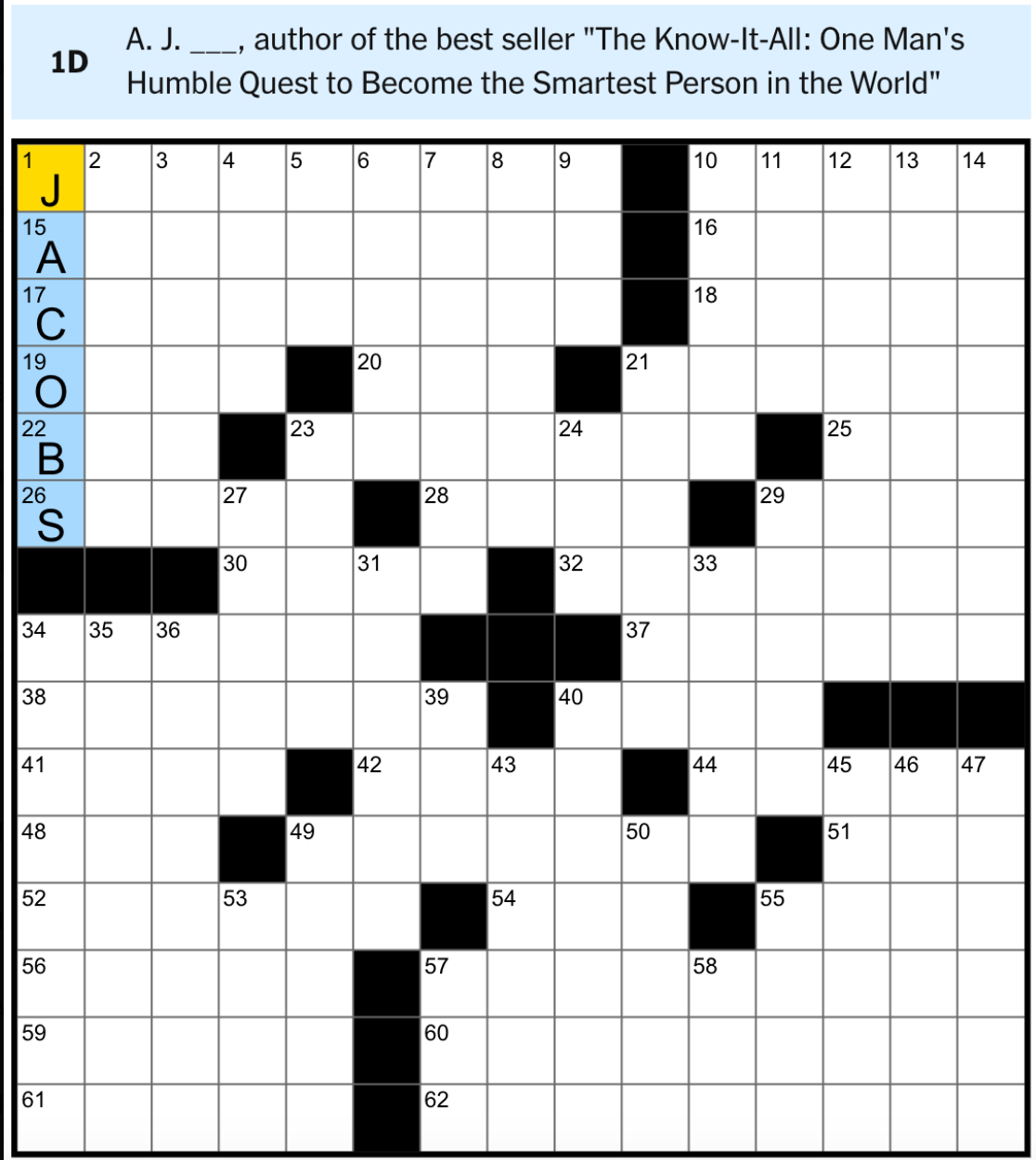
Recently, the novelist Joyce Carol Oates was an answer to a clue in The New Yorker crossword puzzle. When she learned of this, Oates posted on social media, “Who on earth has time for crossword puzzles?”
To which the proper response is, “Who on earth has time to read novels?”
I asked Will about Oates’ comment, and he was too nice to slam her, aside from saying “Wow.” But Will and I both believe crossword-bashing is bunk. Puzzles aren’t merely trivial pursuits. Puzzles foster creative thinking, help stave off cognitive decline, and build community, many of whose members, as Will puts it, are “funny, smart, well-rounded people with quirky minds.” Puzzles create a solution-oriented outlook on life, which we need now more than ever. Oh, and also they are keeping journalism alive by providing a large part of the NYT’s bottom line.
2. PROGRESS IS POSSIBLE
Whenever I despair that the world is just a massive stupidity-induced mess – like a gender-reveal-caused forest fire on a global scale — I try to remember: Many parts of human existence have gotten better. Our lifespans are far longer than they were 100 years ago. Our socks have elastic, so we don’t have to tie little belts to them. And crossword puzzles are great. Especially compared to the first-ever crossword puzzle, which appeared in the New York World in 1913. It was bad. Most clues were boring (e.g. a lion was “An animal of prey” – as opposed to a modern clue such as “Pride parade participant.”). Or else the clues were just ridiculously obscure (“The fibre of the Gamuti palm,” whose answer was “DOH”) (1)
Will has been a huge part of ushering in the Golden Age of Puzzles, where cleverness and twists abound. (In fact, we asked Will to fix the world’s first crossword puzzle, and we will publish the results soon). And it’s not the only art form that continues to improve. Portal 2 is better than Pong, Obsession is better than Thomas Edison’s The Kiss.
3. IT’S NEVER TOO LATE TO FALL IN LOVE
One of the puzzles we gave Will involved guessing words that contained hidden “love” – words like “Slovenia” and “clover.”
It seemed appropriate because Will recently found love, which he said came as a total surprise. At the age of 69, he met his now-husband playing table tennis. (Will is passionate about table tennis, and several years ago, he opened the Westchester Table Tennis Center with the profits from his Sudoku books).
Will told us about their wedding, which was appropriately puzzle-themed – including a scavenger hunt that ended with a quote popularized by Zsa Zsa Gabor: “Love is a game that two can play and both can win.” (2)
4. CREATIVITY IS RARELY THE RESULT OF BOLTS FROM THE BLUE
When Will was interviewing for his dream job as puzzle editor at the NYT, the interviewer asked him, “What would you change?” Will’s response: “First, I told him what I wouldn’t change – which is, the intellectual rigor of the puzzle.”
This is a smart move for any job applicant: Before critiquing the institution, say what you love about it.
But Will’s answer also reflects something both he and I believe: Creativity is usually more about evolution than revolution. It’s rare that an invention or great work of art is the result of spontaneous generation.
This is true across all art forms. Just one example from another man named Will: Romeo and Juliet did not pop out of Shakespeare’s brain fully formed. It was inspired by many other versions of the Romeo and Juliet folk tale, including the 1562 poem “The Tragicall Historye of Romeus and Juliet.”
And it’s true of Will’s career. Consider the enormously popular New York Times Spelling Bee (which would not allow either the word “tragicall” or “historye,” fyi). Will created the puzzle 2015, inspired by a game called “The Polygon” in The Times of London, but he made some important changes: In Will’s version, you can use a letter more than once. And then there’s the clever title and packaging. It makes a huge difference that the title is a pun and the layout contains beehive-like hexagons.
5. SHOW UP…IN PERSON
Will’s big break came when he got a job at Games magazine. Here’s how he landed the job, as he recounted in the Little Village newspaper: “It was in early 1978... I saw a classified ad for a puzzle editor—’Puzzle Editor Wanted.’ It was one of those anonymous ads... From the wording of the ad, I was certain the ad was from Games, which is where I really wanted to work, so I figured I would beat the competition by going in directly.”
“I put on a coat and I put on a tie, took the train into New York City, walked into the office and announced I was there for their position, and it was not their ad; they did not have a position open.”
“The editor saw me anyway. We hit it off, we talked for 30 minutes, I started getting freelance work almost immediately and I got a job by the end of the year.”
I love Will’s chutzpah! And in this digital age, I think showing up in person is even more important.
6. GRIT, RECOVERY, PERSISTENCE – ALL THAT GOOD STUFF!
During the interview, Will opened up to us about his stroke. Four years ago, he found himself incapacitated, alone, and on the floor of his bathroom, thinking “Is this the way I’m gonna die? Lying on the floor in my house?” Will pulled himself across the floor to his phone and called his husband. He spent several weeks in the hospital and is still doing daily physical therapy. “I don’t think I’ll ever be 100% again, but I think I can get close,” he said.
Will no longer uses an electric wheelchair, but he still walks slowly, and has a device on his leg that sends electric pulses to his foot to help him flex his ankle.
He now is back to playing table tennis regularly, though he remains standing in one place while playing. But through it all, there was zero pause in his creativity: “I was making puzzles in bed while I was in the hospital.”
7. YOU DON’T HAVE TO BE AN ASSHOLE TO BE SUCCESSFUL
It’s important to stress: Will is not an asshole. Despite being the most famous person in puzzling, he’s a lovely, menschy guy. Even his rejection letters are nice.
I asked Will for his life philosophy: “I have two things in life. One is that I want to enjoy myself, which I obviously do, and the second is I want to make the world a little better for being here, and I try to do that all the time.”
He’s certainly made the world better for millions of word nerds like me, and I’m grateful for him.
FOOTNOTE 1: Granted, they couldn’t have used the obvious clue for “DOH,” - namely, “Homeric catchphrase” — because 1913 was a couple of years before The Simpsons started.
FOOTNOTE 2: She was married nine times, so she won a lot of games!
BONUS INFO: If you’re not Joyce Carol Oates and you like puzzles, the Hello, Puzzlers! podcast is producing our first card game: Earbus! Updates coming soon.
Love this and the wisdom of Will is beautiful piece of life’s puzzle.
I very rarely attempt any crossword puzzles, but really enjoyed and appreciated this summary of your interview - well done!