

Going Way Outside My Bubble

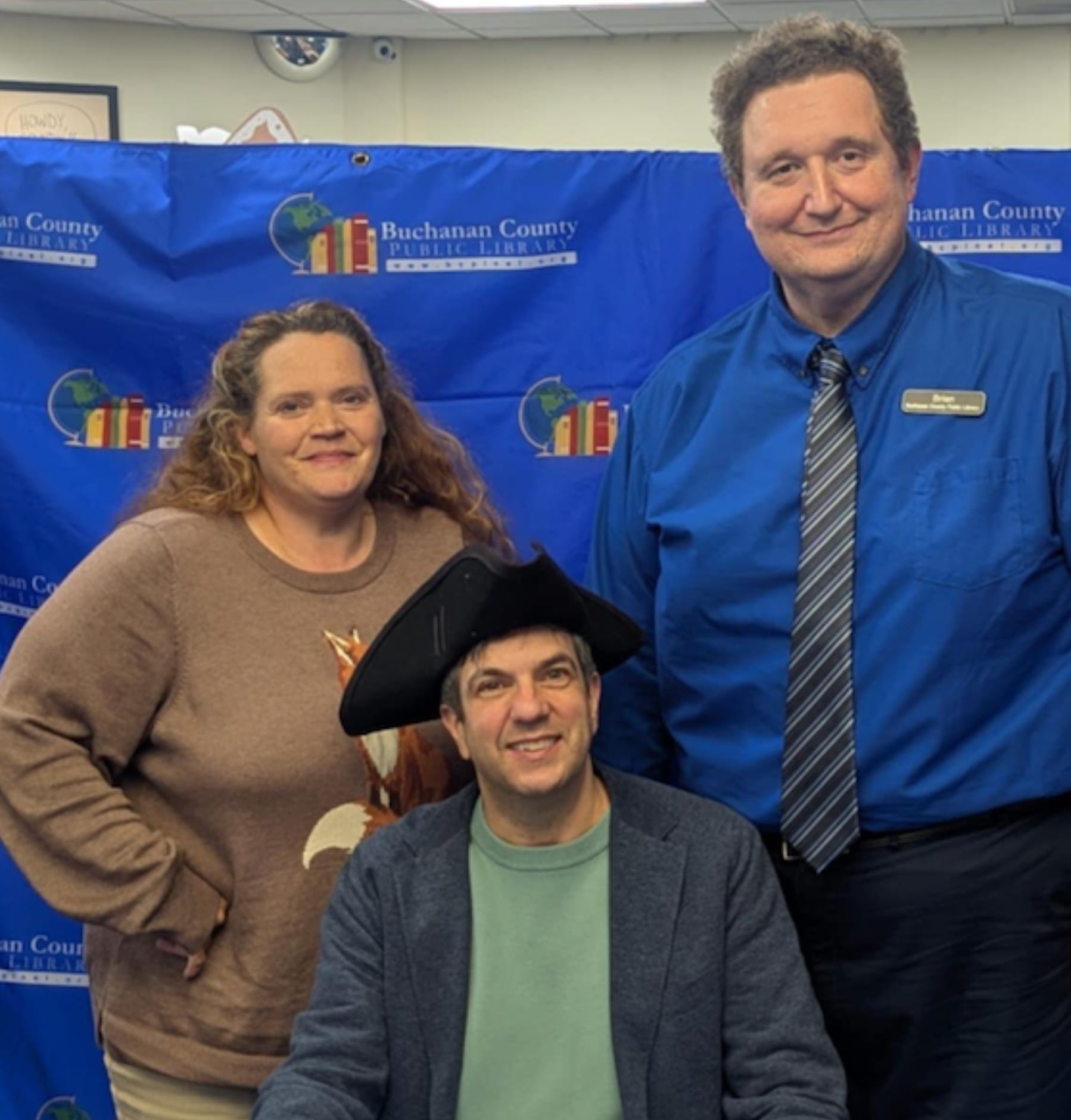
I recently had the most successful book event of my life – at least if you look at it a certain way.
I spoke at a library in Virginia, and 42 people showed up. You might think that’s a decent but far-from-massive crowd. But consider this: The event was in the rural coal mining town of Grundy, Virginia, population 875. On a percentage basis, almost 5 percent of Grundy was in attendance.
If I got the same percentage of attendees at a New York City event, we’re talking 400,000 readers. It’d require a venue the size of nine Yankee Stadiums.
So viewed in that light, my Grundy talk is my most successful book event ever! It’s all about perspective.
I was invited to Grundy a few months ago by two of its librarians. They suggested I come speak at the Buchanan County Public Library about my book, The Year of Living Constitutionally. I agreed, not realizing quite what a shlep this would entail: two plane trips followed by a two-hour drive. But I’m so glad I made the shlep.
First of all, it allowed me to get to know the librarians – Brian Shortridge and Teresa Matney. They are funny, energetic, and extremely well-read. And they’re great at their jobs.
I’m a huge fan of public libraries, one of the most democratic institutions imaginable. And Brian and Teresa are doing what the best librarians do: Spreading the love of knowledge, turning the library into a community meeting-place, and holding events such as their Harry Potter-themed Yule Ball, complete with a plague of chocolate frogs.
As with all good librarians, they are great educators. They took me on a tour of Buchanan County, a town far outside my Upper West Side bubble. (Inicidentally, it’s pronounced “BUCK-annon” because the county leaders wanted to distance it from James Buchanan, who is regularly listed as one of the worst presidents in US history).
I got to see the sites of coal mines and former coal mines. They showed me the river where Teresa once went tubing as a kid – only to emerge with welts all over her body because of the toxic levels of chemicals.
I got a tour of their wonderful library and watched them greet the library patrons with warmth and enthusiasm. They showed me the worm composting station in the basement, one of Brian’s many projects. Plus, they introduced me to one of the most popular sections in the library: Amish-themed romance novels. This is a genre I did not know about, but apparently it’s quite robust. “Anything with a bonnet flies off the shelves,” Brian told me. In fact, the nickname for the genre is “Bonnet Rippers” (a play on Bodice Rippers).
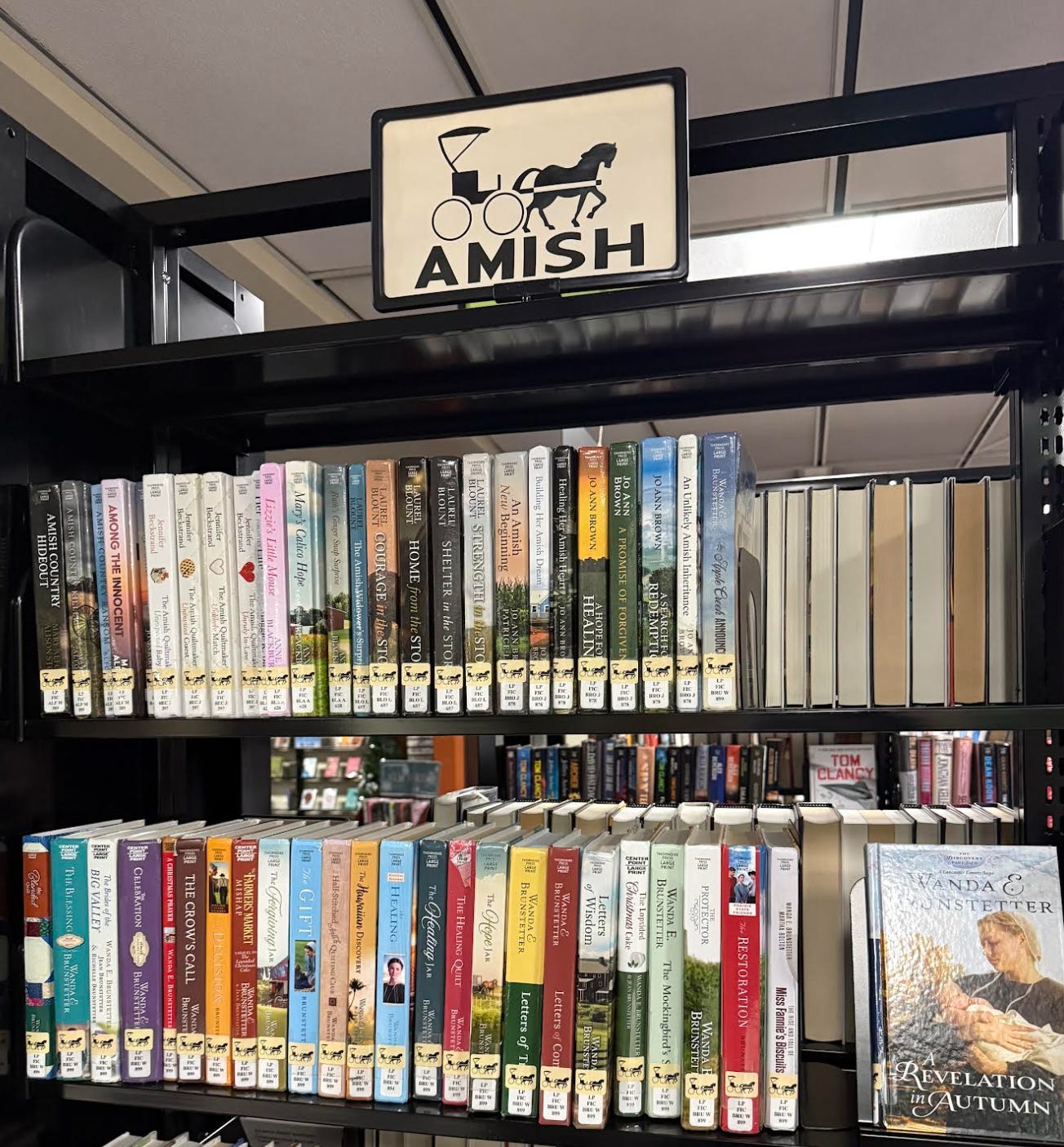
Teresa suggested that I move to Grundy and write a book called “The Year of Living Appalachian.”
“You could do some coal mining, make some moonshine,” she told me.
“So you want me to reinforce the stereotypes about Appalachia?” I asked.
She replied, “Sometimes there are stereotypes for a reason.”
More important, Teresa told me, as part of my year of Living Appalachian, I could shovel her driveway and mow her lawn, since the Appalachian ethos is all about helping out your neighbors.
“Wait – is this idea a ruse to get me to do chores for you for free?” I asked.
“No comment,” Teresa said.
Brian and Teresa aren’t just big readers – they are also writers. They told me that they’d started writing essays about growing up - and choosing to stay - in Appalachia. I asked to see some of their pieces. I thought they were great.
So I encouraged Brian and Teresa to start a Substack and share their work. Which they just did! I was proud to be their first subscriber.
I’m pasting Brian and Teresa’s first essay below, as well as a link to their Substack, “Appalachian Anecdotes.” This first story is about Teresa’s childhood and is co-written by Brian and Teresa. Hope you like it.
(Note: Also big thanks to the great novelist Adriana Trigiani, who hosted the Origin Project event in Richmond where I first met Brian and Teresa).
Creamed Corn
By Teresa Matney & Brian Shortridge
Creamed corn is disgusting. It was disgusting when I was seven years old and 40 years later my opinion has not changed.The difference between now and then is I don’t have to eat creamed corn, hominy, or any other depraved vegetable. It is golden niblets for me, Green Giant all the way. Is that the sign I have made it in life? A great job, a house and name brand canned food.
It seems to be a common debate among older people about who was the poorest, as if it was a badge of honor.
“We were so poor we had to pick the corn out of the chicken manure,” proclaimed a relative once. Which instead of garnering my sympathy for his lack of food, it revealed to my young mind how creamed corn is really made.
The real dividing line amongst most Americans of my generation is food labels. If your label had Del Monte, Heinz, or a cartoon character from a television commercial on it, you were eating high brow cuisine. Betty Crocker, the Trix Rabbit, and the famed Italian Chef Boyardee were far outside the reach of my family, but that was not always the case.
My daddy was a coal miner and by the late 1970s that meant he made a good living. Even with a wife and 7 children to support we were living the American dream, which included a new trailer, food on the table and shoes on our feet.
He didn’t work at a large mine. It was a non-union truck mine, but the price of coal and the demand for workers was high enough that for a while, he was really bringing in the dough.
My memories of going to the grocery store in those days was quite an adventure. We looked forward to it all week.
“Go ahead and get what you want,” Daddy would announce to us. We raced through the grocery store filling up the buggy. It was like a scene from one of our later favorite game shows, SuperMarket Sweep. Candy, cakes, chips, anything our hearts desired.
In no time our buggy was loaded down with a graveyard hump piled on top. Daddy would walk to the register and pull out a large wad of cash to pay our bill. It seemed my Dad walked taller and straighter in those moments. Mommy said he looked like Elvis and sang like George Jones.
Our house was loud and lively then. Even with a house full of kids, it seemed like someone was always coming over or dropping by. Daddy had a way of attracting those in need and Mommy seemed to thrive with more people in the house, even as she complained about it. Years later, one of her greatest joys would come at Christmas time. After counting, she would call her friends to tell them how many people showed up to our house for dinner. A number that regularly reached into the mid twenties.
Then it all changed. Daddy’s back was broken in a mining accident and everything got quiet. Gone where the sleepovers, tag in the house and impromptu singalongs. He was suddenly home all the time, mostly hidden away in his room in bed, demanding silence.
The coal company fought compensation, so for nearly two years our family had little to no income. Instead of rushing through the aisles of the store with Daddy, Mommy would arrive home with brown paper bags filled with canned food purchased with food stamps.
As supper time approached, my two youngest brothers, my twin sister and myself would gather around mom.
“Let’s play a game,” she would announce as she reached into the bag and pulled out a can, a can with no label. Mom, trying to stretch her food stamps farther, would purchase grab bags of canned food, some of which were dented and most would be without labels, which would later explain her habit of buying out of date food and hoarding it.
“What’s in the can,” I asked.
“Well you see, that’s the game,” said Mommy. “We don’t know what’s in the can or what we are going to eat for supper. So let’s open some cans and see what surprise is inside. Who wants to open one?”
Of course we all squealed, “Me, Me, Me”, but even as a child I should have known Mommy would hand the can and can opener to Walter, her baby boy and her favorite.
In later years she would say, “I love all my children the same, but some I like more than others.” We all knew she was lying. She loved Walter the most, though we didn’t hold it against her because we all loved Walter the most too.
We would usually open three cans which often resulted in unusual meals. Most of the cans would be creamed corn, hominy, carrots, or mixed vegetables. Then, a miracle would happen and it would be a can of fruit cocktail. Never has anything tasted so sweet in my life than fruit cocktail from a dented mystery can.
Mommy would heat up the cans of food and feed us. She never took a bite until all of us were fed, a practice she continued even as she grew older and had grandchildren and great-grandchildren to come visit her.
We never got to go to the store and get what we wanted again. Even after Daddy received his Social Security Disability payments, money would always be tight. We graduated back to canned food with labels, but Tony the Tiger, Campbell’s Soup, Aunt Jemima and Lays Potato Chips would remain elusive for me even into adulthood.
Did we have any Grey Poupon? No, we didn’t even have French’s Mustard. What we did have was a Mommy who tried her best to keep us fed. I am pretty sure feeding creamed corn to a child is considered cruel and unusual punishment today.
I am not writing this story to garner sympathy or out of shame. Rather I am telling this story to remind myself that sometimes I don’t get what I want, but what I need. At that time, what I needed was a strong mother that would turn the bad times in our childhood into some of the fondest memories of my youth. I have to admit that I don’t get the same thrill out of opening a can of Fruit Cocktail today as I did then, but it does always bring a smile to my face.
Thanks for introducing us to the librarians!
Thank you for the story!
Can’t wait to read more