

Life Lessons from a Board Game

Whenever I’m feeling annoyed about something less than consequential (e.g. that the Hilton Hotel rewards program spams me four times a week despite multiple attempts to unsubscribe), I repeat the following mantra:
Surgery without Anesthesia
I find these three words a miraculously effective way to regain perspective.
Whatever challenges I may face in my life, I will never have to undergo surgery without anesthesia, which was the norm for tens of thousands of years of human history.
I came up with that mantra many years ago when reading the encyclopedia. It was one of the starkest examples of an important fact: The good old days were not good.
We face a series of stunning challenges today (the threat of authoritarianism, A.I., Tik-Tokkers recommending a biblical diet). It’s an uncertain and frightening time. But that’s no reason to have nostalgia for some non-existent Edenic past. History was a sexist, oppressive place where germ-filled people poked around your internal organs while you were wide awake.
Surgery without anesthesia came up recently in another context: The board game Operation. For my podcast, I spent a surprisingly interesting afternoon researching the history of Operation – that game where you try to remove plastic body parts with a tweezer without triggering the buzzer.
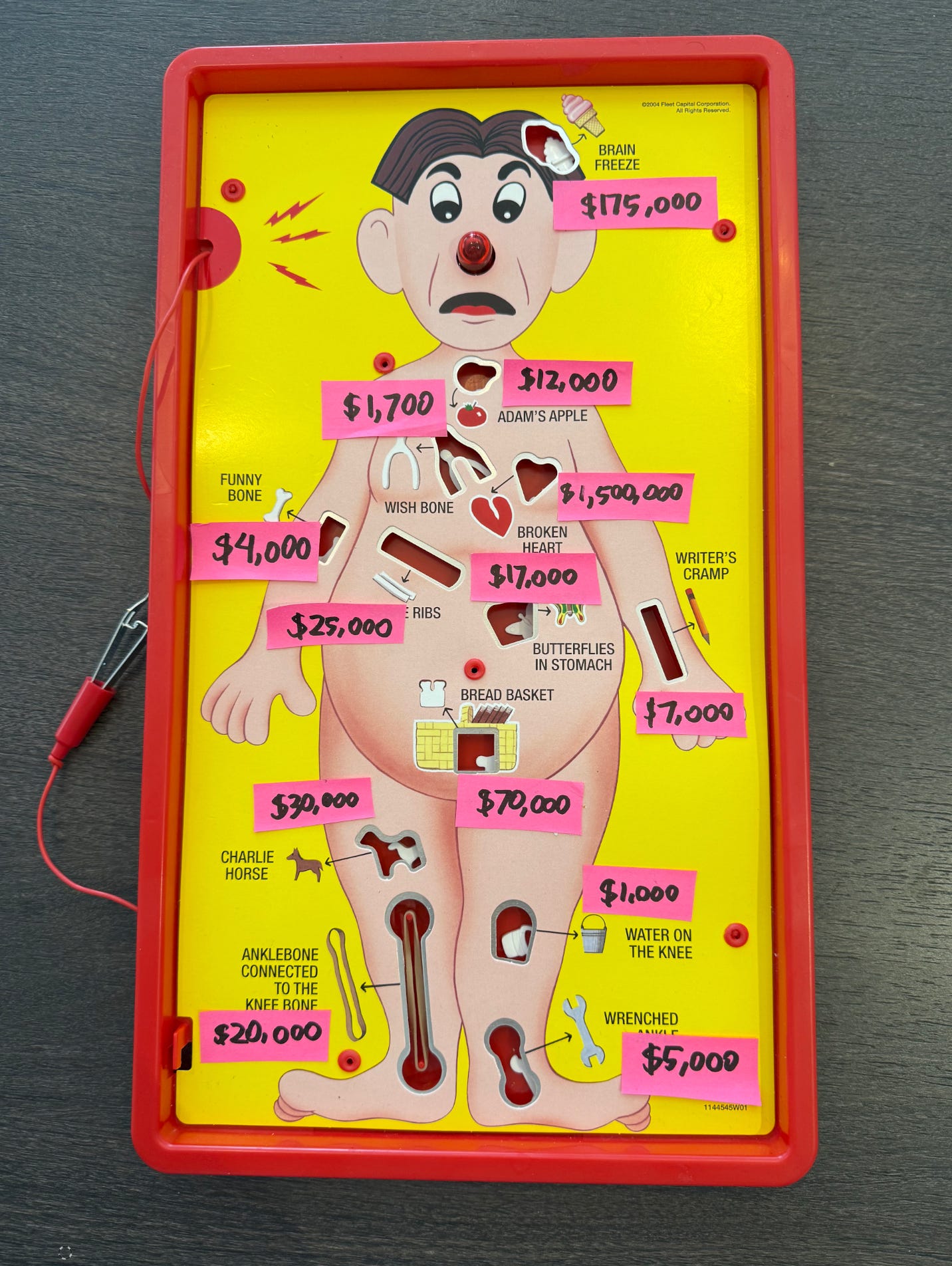
I’d never noticed it before, but the patient in Operation (who is reductively named “Cavity Sam”) is wide freakin’ awake. Sam’s eyes are open, and his eyebrows are justifiably raised in pain and terror.
Operation has to be the most sadistic board game in existence (though I also object to Monopoly’s lack of due process in players going directly to jail. Remember the Sixth Amendment, people!).
That wasn’t the only lesson I took away from my odd afternoon of board game research. My time exploring this rabbit hole (rabbit cavity?) led to some surprisingly wise takeaways.
Lesson #1: Look for inspiration everywhere, even the sewer.
For my research, I watched a documentary about the history of the board game Operation. It turns out the co-inventor of Operation – John Spinello – got the idea for the mechanics of the game while using a stick and some melted tar to retrieve coins from a sewer grate. (FOOTNOTE 1)
I love learning about where people get their ideas. One key to creativity, I believe, is to be constantly on high alert for unexpected connections and metaphors.
You can be annoyed by the burrs sticking to your socks after a hike. Or you can be inspired to invent Velcro, as did Swiss engineer George de Mestral.
Lesson #2: Thinking about the greater good can save you from a lifetime of bitterness.
Spinello came up with the basic idea for Operation in 1964. He took it to a toy company and sold the rights for $500. And then…nothing. He never got another penny from the estimated 45 million Operation sets sold.
Millions of people have spent thousands of hours extracting Adam’s Apples with tweezers, and the man who came up with the idea earned less than a thousand bucks.
How pissed is Spinello? How choleric is his gallbladder?
Spinello says that instead of being bitter about the money he didn’t make, he tries to focus on the joy that the game has brought to people over the years.
What a reframe! Imagine if we all had such a Buddhist and magnanimous outlook. What a way to save our sanity! Instead of stewing over the pirated versions of my books available for free on the Internet, maybe I should remind myself: Well, at least my message is reaching more people.
Important caveat: This is not to say we should passively accept injustices. I can still report the pirated versions to my publisher and get them shut down – AND try to curb my rage by thinking about the big picture.
Lesson #3: Our universe might have been scripted by O. Henry.
By which I mean that life is often ridiculously, poignantly ironic, with millions of real-world The Gift of the Magi stories occurring every day.
In the documentary, we learn that Spinello quit game design and opened a car repair business. About a decade ago, he went bankrupt. Which left him with no money for…yes, you guessed it…an operation.
Spinello needed $25,000 for jaw surgery.
Two of his friends – who were also the ones who produced the documentary – started a crowdfunding campaign, and got him the money. Spinello got his jaw fixed, presumably with more anesthesia than Cavity Sam.
Lesson #4: The American healthcare system is a monumental mess.
This was not a huge surprise. But still, Operation drives the point home. The game features 13 operations ranging in price from $200 to $1,000. The total bill for all the operations is $6,400.
As a journalist, I felt it important to investigate how much would those 13 surgeries cost in a real hospital in America today. Do you want to guess?
The answer is…
$1,867,700
Or so. Prices vary, but that’s a reasonable estimate.
Here’s the breakdown, according to an afternoon of Googling (time well spent!)
-Funny Bone (aka Cubital Tunnel Release): $4,000
-Wishbone (aka Distal Clavicle Excision): $1,700
-Adam’s Apple (aka Tracheal Shave): $12,000 (FOOTNOTE 2)
-Spare Rib (aka Rib Removal): $25,000
-Bread Basket (aka Gastrectomy): $70,000
-Broken Heart (aka Cardiac Transplantation: $1,500,000
-Writer’s Cramp (aka Tendon Release Surgery): $7,000
-Charlie Horse (aka Leg Stent, or endovascular revascularization): $30,000
-Brain Freeze (aka Brain Tumor Removal): $175,000
-Butterflies in Stomach (aka Vagotomy, to reduce stomach acid production): $17,000
-Anklebone connected to the Kneebone (aka Peroneal Reattachment Surgery): $20,000
-Wrenched Ankle (Ankle Arthroscopy): $5,000
-Water on the Knee (Arthrocentesis): $1,000
Julie and I are lucky enough to have insurance. But even so, the appendix surgery I had a few years ago cost us $10,000. And that was after Julie spent countless hours negotiating down from $30,000.
I’m not enough of an expert on healthcare policy to know the best way to fix these out-of-control costs. Nor am I saying that other countries have perfect systems. But there’s got to be a better way for Cavity Sam to get healthy without being reduced to poverty.
In the comments, I would love to hear what you think are the best ways to make surgery more affordable. (Some of the suggestions I’ve read about include more price transparency laws, price caps, and moving closer in the direction of the Canada model).
Thus concludes my thoughts on surgery and surgery-based board games.
Perhaps in a future column I will write about life lessons from other board games. I have a lot of additional thoughts about Monopoly, which I believe – hot take alert! – is a terrible, terrible game, not only because it needs serious judicial reform.
FOOTNOTE 1: To be more accurate: Spinello was the co-inventor of the game. He came up with the idea of having a game where you use a tweezer without setting off an electric buzzer. But making the game about surgery was a later development that seems to have originated at the game company.
Occasionally, great games or works of art are born fully-formed by a single person. But I find, more often, they are an accretion of ideas from multiple people.
FOOTNOTE 2: Why is Cavity Sam getting his Adam’s Apple removed? Is it possible he/she/they was one of the first representations of trans people in pop culture? Let me know your thoughts.
AJ, you are hands-down my favorite rabbit hole (cavity) instigator, guide, and narrator. What a fun and fascinating piece. And a great reminder that we have it good. Anesthesia rocks.
beautiful essay. the health care system in on the brink... we need a completely new disruptive innovation- the tyranny of the office visit. Love the reframe and sending love to my nurse anesthetist friends! no cryin on the yacht!