


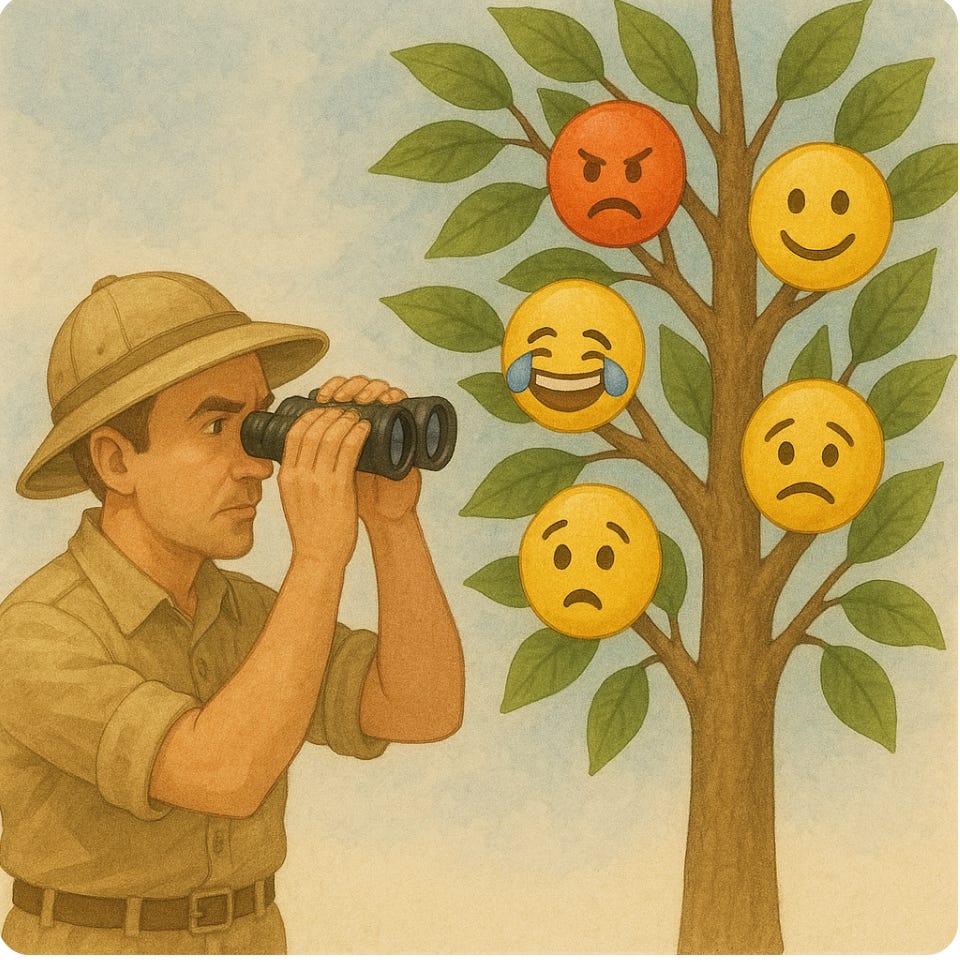
I’ve been birdwatching a couple of times over the years, and found it moderately enjoyable. But I’ve taken up a similar activity that I’m absolutely loving: Moodwatching.
Instead of trying to spot birds in the wild and check them off a list, I’m trying to notice my emotions as they appear throughout the day, and check those off a list. My thesis? Our inner lives are as fascinating and diverse as the wildlife on the Galapagos Islands.
I’ve been Moodwatching for three weeks now, and it has been a hugely positive experience (one moment please, while I check off my “gratitude” box). Seriously. It’s been a profound boon to my mental health. It’s intensified the positive emotions, allowing me to savor joyful moments longer (My sons still agree to play Rummikub with me!). And it’s helped blunt negative emotions by forcing me to interrogate them (Do I really need to get angry that the Spelling Bee is 240 points today? No one is forcing me to do it.)
It started a few weeks ago. I’d been reading research about the benefits of what psychologists call emotional awareness. There’s a ton of evidence that noticing and labeling your emotions can help with self-regulation, spotting unhealthy patterns, and figuring out what makes you happy. It’s a core theme in several evidence-based therapies such as Cognitive Behavioral Therapy, Dialectic Behavioral Therapy, and Acceptance and Commitment Therapy.
I found a psychology website with a worksheet that you’re supposed to fill out at the end of the day. It asked, “What made you happy today, and what made you upset?” For me, the worksheet was a flop. I can barely remember what I was feeling five minutes ago, much less what made me angry or joyful 12 hours ago.
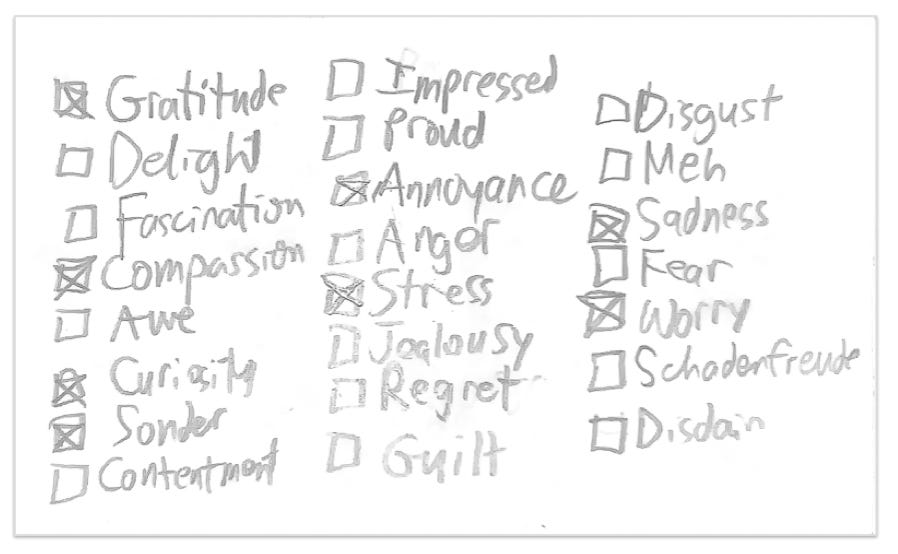
I needed a tool that would allow me to track my emotions in real time. So I made my own. Inspired by those birdwatching lists where you check off boxes (American goldfinch! Yellow-billed magpie!), I wrote twenty emotions on an index card with a pencil. I drew little boxes next to each. I included both positive emotions (e.g. gratitude, delight, contentment) and negative ones (e.g. anger, jealousy, disgust).
I keep the card in my pocket along with a minigolf pencil. And, throughout the day, whenever I feel an emotion, I tick off the box. Then, on the back of the index card, I scribble what triggered that emotion (Amusement! the crib scene from Nathan Fielder’s HBO show). I find checking the boxes highly satisfying. The next day, I start again with a new card and empty boxes. I considered calling my creation an “Emotional Safari” or “Emotional Checklist,” but settled on Moodwatching.
I know it’s ridiculously analog for the Smartphone Age. When I take my index card out, I can see some of my friends mentally checking off their own “baffled” boxes. (Though a couple of other friends have had the opposite reaction: They’ve converted and joined me with their Moodwatching cards.)
But Moodwatching is working for me. Partly, it’s the game-like element. I went on an African safari several years ago, and one of the goals was to spot the Big Five mammals (lion, leopard, elephant, rhino, and African buffalo). I’ve got my Big Five positive emotions that I try to experience every day (gratitude, compassion, delight, fascination, and awe). I usually get three or four – that “awe” can be elusive.
But the true benefit for me hasn’t been racking up points. Instead, the true benefits come from the real-time experience of charting my emotional journey — both its highs and lows — and the insights that this provides. The benefits include:
EMOTIONAL WISDOM AND PERSPECTIVE
Even though I’ve been experiencing emotions for more than five decades, I still fall into a classic trap. If I wake up feeling sad and overwhelmed by the world, I’ll conclude: Okay, this is the permanent and correct way to feel. I will feel sad and overwhelmed by the world for the rest of the day – and the rest of my life.
Oh, brain. You can be so gullible. My Moodwatching card is a 3-by-5-inch proof that this is pure rubbish. Every day of my life, I have experienced a wide range of emotions, both good and bad. Moodwatching reminds me: this too shall pass. I will feel joy again – and I will feel annoyance again.
Plus, it gives me a helpful birds’-eye view of my emotional patterns. For instance, I’ve noticed my mood often dips between 3 and 5 p.m. (a period of time when I check off the worry and regret boxes multiple times). It reminds me that dip isn’t necessarily an objective reflection of my place in the universe. Maybe I just need a nap.
ENHANCING POSITIVE EMOTIONS
Last week, I was having lunch at a Mexican restaurant with a friend who told me a delightful story. So I took out my card and checked off “Delight,” then jotted a three-word reminder of what triggered it. He asked me what I was doing, so I explained.
“That’s so spontaneous!” he said.
He was teasing me for not living in the moment. But the weird part is, for me, Moodspotting does help me live in the moment. It allows me to savor and prolong the bright spots. They don’t just flit by. My oldest son came home from college and, for the first time ever, is now officially taller than I am. When he was young, I spent months worrying because he wasn’t growing as fast as his peers. After we stood back to back the other day, I marked the gratitude box, and let my mind linger on my joyful defeat. (Note: I’d already marked the gratitude box earlier in the day, so I just made a hash mark next to the box, which is how I record multiple instances.)
Far from distancing me from my positive emotions, Moodspotting has intensified them.
BLUNTING NEGATIVE EMOTIONS
Psychologists point out that noticing and labeling negative emotions can take away much of their mystery and power. I’ve found this to be true.
When I interrogate my anger or annoyance, it often evaporates. Not always, but often. A couple of days ago, I got annoyed that the building superintendent interrupted my workflow by ringing the doorbell to come fix the leaking shower. As I was making an X in my annoyance box, it occurred to me that I was being remarkably petty. My wife, Julie, had spent far more time than I did setting up the appointment. And the guy was actually there to help. The annoyance was still there, but I tempered it with gratitude that the shower was getting fixed by someone who actually knows the different sizes of Allen wrenches.
Not everything is a petty annoyance. There is plenty going on in the world right now that inspires genuine anger and fear in me. These are objectively stressful times. But in those cases when the anger is justified — for instance, in my opinion, the defunding of medical science — I find checking the anger box is still helpful. It reminds me not to just wallow in rage, but to try to come up with real solutions.
Moodwatching is a great tool for reframing — for spotting black-and-white thinking, ruminating, and all those other bad mental habits.
BECOMING AN EMOTIONAL CONNOISSEUR
Just as a winetasting course might teach you to discern various notes in your Chardonnay (apricot, with a smoky finish, etc.), my Moodwatching has made me better at spotting the various subtleties in emotions. The difference between fear and worry, for instance. And it’s reminded me that emotions are rarely clean-cut. They’re often a hodgepodge. After talking to a sick friend, I might check off happy, sad, and grateful all at the same time. Psychologists call this skill “emotional granularity.”
Yesterday, I picked up my iPhone even though I didn’t recognize the number. It was an elderly woman I didn’t know who talked for two minutes straight about the chocolate matzoh she allegedly sent me. It turned out she had dialed the wrong number. When I hung up, I realized I wasn’t feeling pure exasperation – more like 60 percent annoyance, 30 percent amusement, 10 percent compassion for her confusion.
MOODCHASING
Moodwatching isn’t passive. It requires you to pay attention. And it can sometimes inspire you to go even further – it can inspire you to chase an emotion. For instance, one of my favorite emotions is called “sonder.” Perhaps you’ve heard of it. This is the realization that everyone you pass on the sidewalk has an inner life as complex and nuanced as your own. When I look at my index card and see the empty box next to “sonder,” I’ll sometimes go on the hunt. I’ll look out my window and try to imagine the world from the point of view of the guy walking his three dogs across the street.
As with everything, there are drawbacks to Moodwatching. I’ve mentioned some of them above. The raised eyebrows, for instance. The risk that you will be accused of navel-gazing (which I actually find to be untrue. Moodwatching often inspires me to have more compassion and sonder, which are the opposite of navel-gazing).
But overall, I’m a big fan of Moodwatching. In fact, I hope it catches on. I hope some of you try it out, even if in a less intense way. Maybe just keep track of five emotions instead of 20. Or maybe just do it for an hour this Saturday or Sunday instead of a whole day. I’d be delighted to answer questions on best practices and trade tips with others.
I love the paper-and-pencil version because then I’m not tempted to poke around on my iPhone, but maybe some would prefer to do it in their Notes app. Whatever works.
I’ll sign off now with another big check of my Gratitude box for those who subscribe to Experimental Living. Thanks!
☑️ curious ☑️ moved
☑️ thankful 🤔😀🙏🏼
Way to go, A.J.!!!
I am a fan of A.J. Jacobs' work as well as a certified practitioner of the Emotion Code (and Body Code and Belief Code) which explains how unnoticed, unfelt, unprocessed emotions can get stuck in the unconscious mind. These unconscious, trapped emotions influence our thoughtsl and actions without us even realizing it.
Kudos to you for coming up with your own method to feel, acknowledge and release unwanted emotions before they become trapped.
Annette Sofka