


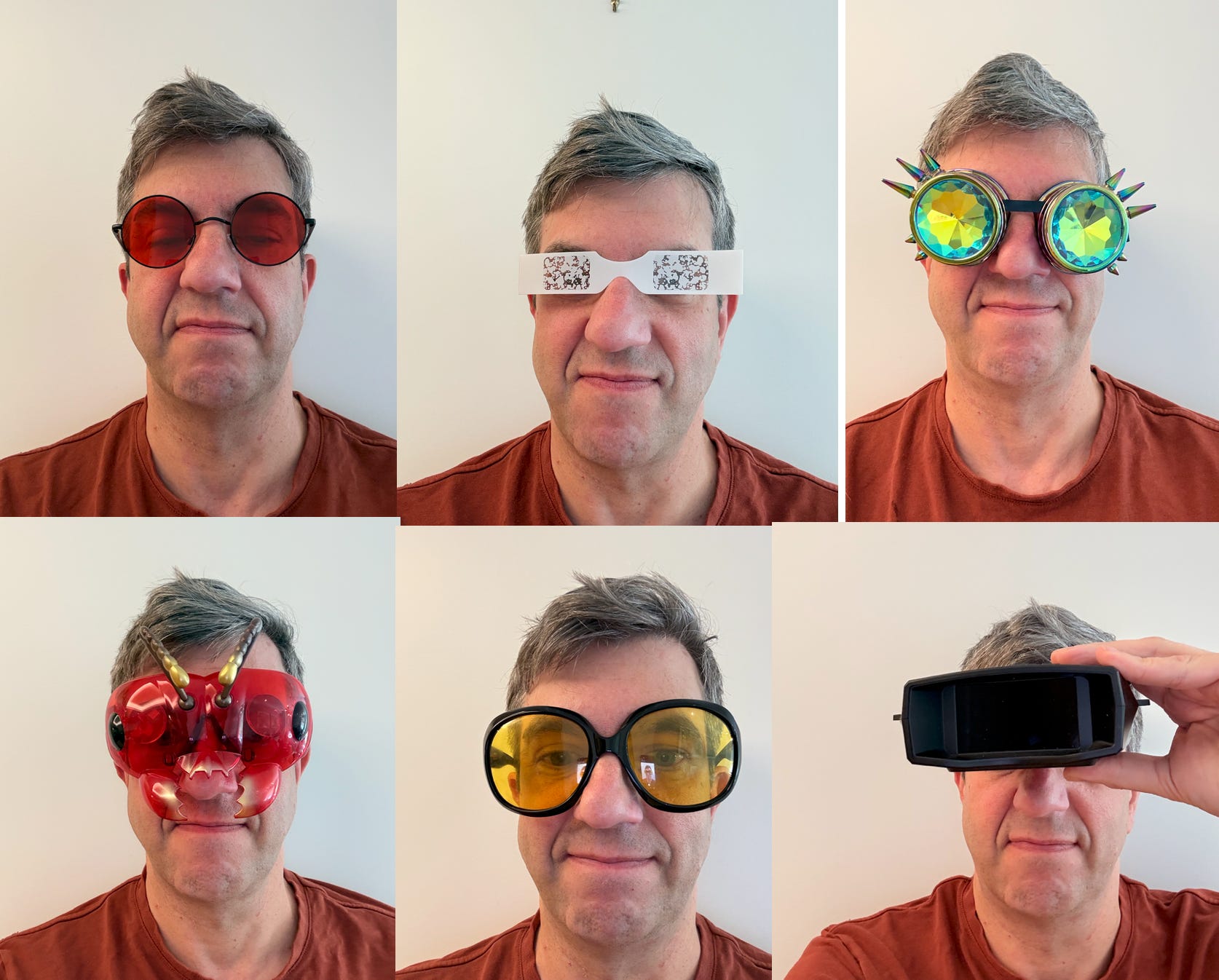
It all started because I was curious about the phrase “seeing the world through rose-colored glasses.”
I wanted to know: Do rose-colored glasses actually make you see the world more positively?
So, I bought a pair and wore them for two days straight.
Did they work? Kind of. At least for a while. The world appeared a bit softer, less threatening. I felt like I was living in a giant version of Elle Woods’ bedroom – pink everywhere. When I read a pink email on my pink laptop screen about a pink unpaid bill, it was just a skosh less annoying.
My psychological boost didn’t last. By the second day, I’d adjusted to my new reality. Not to mention that I looked embarrassingly goofy -- Julie asked me if I was starting a Janis Joplin tribute band.
But the rose-colored glasses sparked my curiosity. What could I learn from seeing the world through other types of lenses? So, I ordered some glasses. And then I ordered some more. By the end, I had 14 types of vision-altering glasses, including:
--Yellow-tinted glasses
--Rear-view glasses
--Night vision goggles
--90-degree-shifting prism glasses
--Goggles that simulate what it’s like to be “totally wasted”
--Goggles that simulate what it’s like to be on Molly/LSD
--Glasses to make you see like an insect
I tested all my new glasses over the course of a week, wearing them each for several hours to a day, both indoors and out. I got lots of feedback from family members, who made sure to walk 20 feet behind me in public.
But it’s been worth it. The Multiple Lenses Project has been a fascinating experiment. Revelatory and humbling. I learned a lot about the limits and distortions of human vision. And perhaps more important, it allowed me to think about metaphorical lenses. How we view everything – life, history, our relationships – through specific lenses and filters. And how important it is to shift lenses, to see the world from multiple points of view, especially in these polarized times.
But before I expand on that, let me tell you three lessons I learned from my collection of 14 literal lenses.
Lesson Number 1: We see only a small slice of reality.
Imagine if you’d only tasted the most common fruits -- apples, oranges, pears, bananas. You’d never had a bite of papaya, mango or passionfruit, or the 6,000-or-so other edible fruits the world has to offer.
That’s kind of like our vision. The Multiple Lens Project drove home a humbling lesson: human vision captures just a small slice of what’s out in the world. There’s so much out there we cannot perceive.
First of all, we only see what’s in front of our face. I’m jealous of insects that have 360-degree vision. I’m annoyed that evolution has cursed us with dumb forward-facing eyes. So I bought glasses equipped with rear-view (you can glance to the side to see the world behind you). This all-round vision is both disorienting and empowering. I felt a little less paranoid. I liked knowing what was going on behind my back. Not that I’m expecting a mafia hit soon, but Julie sometimes (unintentionally) startles me by coming up behind me while I’m working. Not a problem with these bad boys.
Secondly, unlike cats and owls, we humans have terrible night vision. So I bought night vision goggles and walked around my apartment after dark. Again, fascinating. Intellectually, I’ve grasped the concept of object permanence since I was five months old. Things don’t just disappear when they are out of sight. But when the lights are off, I still forget that the world still exists as concretely and vividly as it does in daylight. So it was startling to see the titles of books on the bookshelf lit up in eerie green light. They’re still there!
Third, we can’t see tiny things. So I got a microscope camera that I attached to Julie’s iPad and got a look at the hidden world I was missing -including the ocean of tiny pink mushrooms on my tongues surface.
The bottom line: Human vision is severely limited. It’s a tiny slice of reality. In fact, as I’ll discuss in a moment, we only see a small portion of the electromagnetic spectrum. We don’t see infrared. We don’t see ultraviolet, as do butterflies and bees. Our band of visible light is narrow – just a tiny sliver of a much bigger spectrum.
Lesson Number 2: We are bad at noticing.
Even for those objects in our vision, we’re absurdly selective about what we notice. Perhaps you’ve seen that video of the unseen gorilla among the bouncing basketballs? It’s a great example of inattentional blindness: when we focus on one thing, other obvious things can disappear from our awareness.
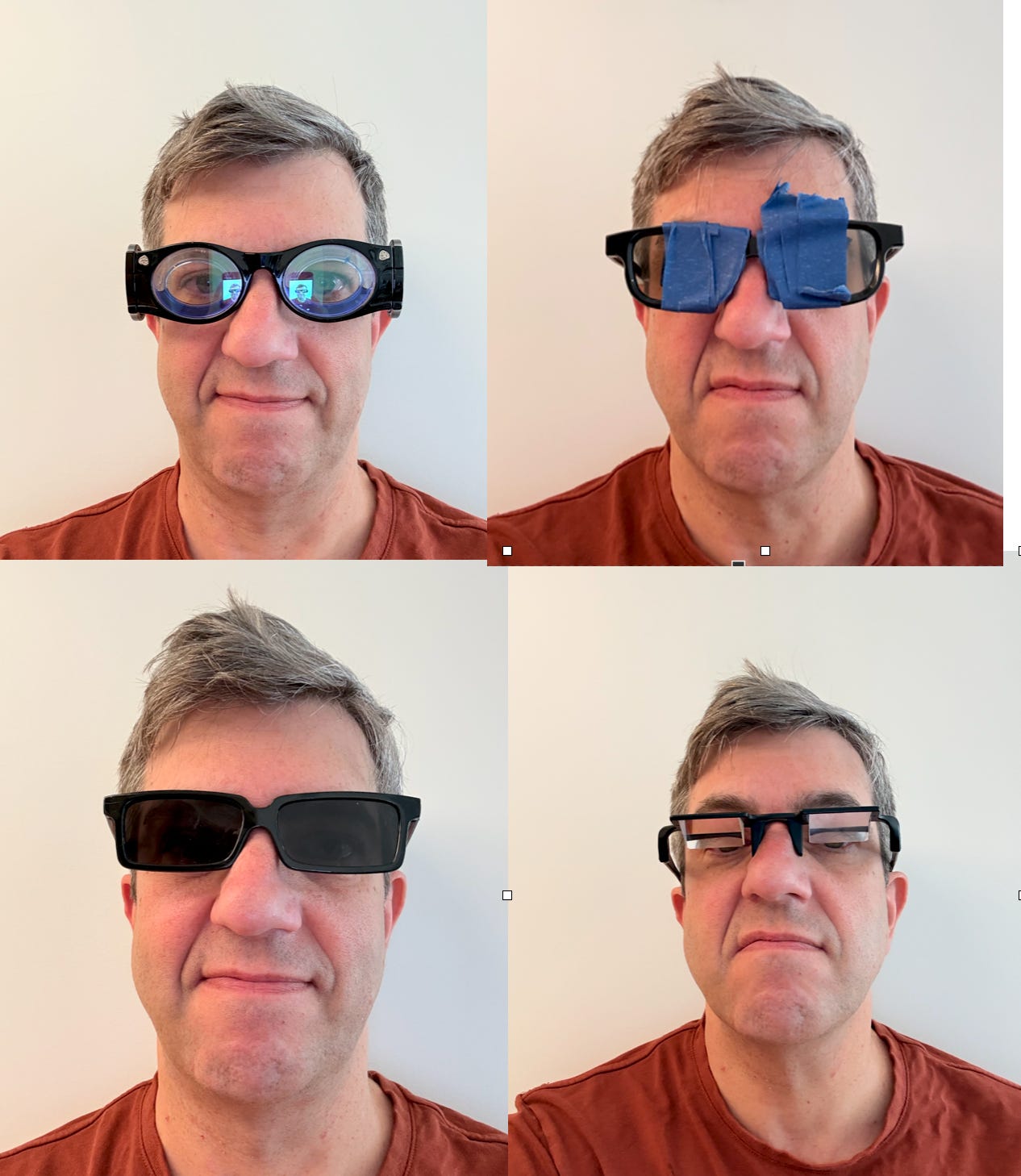
A couple of my glasses drove home my failure to notice what’s around me. First, I wore glasses that ONLY allowed peripheral vision. They were quite DIY. I took a pair of glasses, and covered the center of the lenses with masking tape but left the far left and right sides uncovered. I don’t recommend this for long-term use, especially when walking around NYC streets, which was terrifying. But the goggles provided epiphanies. They allowed me to focus on the margins I usually ignore. For the first time in fifteen years, I really noticed the artwork on our apartment walls (including the collage by our son of a boy giving a thumbs-up, which looks more like he’s flipping us off, which made me chuckle).
Second, I gave the 90-degree prism glasses a whirl. These lenses shift the world by a 90-degree angle. If you’re standing up with your eyes straight ahead, you see the floor. If you’re lying with your head on the pillow, you’ll see your feet – allowing you to read a book without holding it aloft.
The prism glasses were also a bit scary – I had to walk zombie-style, with my hands extended in front of me to prevent wall-crashing. But the new perspective also allowed me to notice things I missed. When typing, the glasses made me focus on the keyboard, not the screen. For the first time, I noticed that the semicolon is taking up prime real estate – right under the pinkie. What the hell, semicolon? I also got to look at the back of my hands. Contrary to the proverb, I don’t know them well. I got to know the fascinating mesh of veins and tiny wrinkles.
Lesson Number 3: Different lenses shape reality in different ways.
Reality looks very different depending on the lens.
I already mentioned the Elle Woods Effect of my rose-tinted glasses. I also tried yellow-tinted glasses, because a friend told me yellow lenses made him happier (yellow is the color of smiley-faces, I guess). For me, the effect was more instant nostalgia. It turned the world into a yellowing old newspaper photograph.
Speaking of color, I loaded an app on my iPhone called Color Blind Pal. This app helps people with color blindness identify colors, but it can also be used to simulate what it’s like to see the world from the perspective of a person with colorblindness. I held my iPhone up to my closet to see the familiar red blazer turned gray.
But color blindness is a relative term. Most humans are blind to colors with wavelengths shorter than 380 and longer than 750 nanometers. And most of us have never seen the color olo. I’d never heard of olo until a week ago. I learned about it from a fascinating article in The New Yorker. Apparently, some scientists claim to have been able to stimulate cone cells in a way that reveals a mind-bogglingly intense green most humans have never experienced. The color is named olo.
Moving on from color, there are a whole host of glasses and lenses that alter your vision to educate, to teach compassion, or just for kicks.
I bought glasses that mimic the fuzziness of cataracts and the tunnel vision of ring scotoma. Which made me simultaneously sad for those afflicted (including, perhaps, my future self) and grateful for the vision I do have, even though I’m both increasingly near-and farsighted.
I also found a company called “Drunkbusters.” They make ski goggles that are supposed to discourage teenagers from binge-drinking and drunk driving. They claim the goggles replicate the vision of a “totally wasted” person. To me, it was more like looking through a funhouse mirror: The world was tilted, blurred and doubled. My son tried them on and said, “I have a sudden urge to send a text I’ll regret later.” I also bought the Molly/LSD goggles, which just seemed like a “totally wasted” person who’d had another beer.
In one sense, all these glasses are distorting reality. But distorting is a tricky word. Because even 20-20 sober human vision is distorted – or at least tansformed and highly edited. Our brains distort the signals in numerous ways, both helpful and unhelpful. We divide the world into figure versus ground, we fill in missing edges and our eyes’ blind spots, we smooth out color when the light is uneven, and on and on. These alterations are usually beneficial, but they can backfire as well.
The Importance of Different Metaphorical Lenses
As I mentioned, the Multiple Lenses Project allowed me to think about metaphorical lenses in addition to literal lenses. I believe we view everything – life, history, our relationships – through specific filters.
As a high schooler, I went through a Marxist phase, and saw everything through the lens of class struggle. It can be a useful lens. It can make you aware of the wealth imbalance and the shortcomings of our current system.
But if that’s your only lens, I think it’s too limiting. I now look at the world through many lenses. Sometimes I’ll put on my behavioral economics lenses – and notice how much of human behavior is shaped by irrational cognitive biases. Sometimes I’ll put on my physics lenses and think about how everything I see (peanut butter jars, chickens, cruise ships) are temporary aberrations on the road toward maximum entropy.
All these lenses have their pros and cons (some have more cons than others). All highlight one version of reality, but not the entire thing. I believe the best approach is to have a collection of multiple lenses with which to view reality, and to constantly switch them.
Perhaps you’ve heard of the famous essay by Isaiah Berlin titled “The Hedgehog and the Fox.” It’s based on an ancient Greek idea about two types of thinkers. A hedgehog views the world through a single lens, whether that’s Marxism or Christianity. A fox views it through multiple lenses, combining approaches and strategies. The saying goes, “The fox knows many things, but the hedgehog knows one big thing.”
Let me put in a plug for one of my favorite lenses: The telescopic lens. I love the telescopic lens. Every morning, I try to zoom out. Way out. I remind myself that my experienced reality is just a tiny sliver of the whole. I’m one of eight billion people on Earth. The Earth is a tiny corner of the vast universe. I’m here on Earth for an eensy portion of the universe’s billions-of-years-long cycle, like a single frame in a three-hour David Lean epic. Some might find this perspective depressing, and maybe it is. But I find it humbling and compassion-building.
One last lesson this experiment taught me: The importance of noticing the lenses themselves. One of my favorite parts of wearing my 14 lenses was the feeling I got when I took them off. The jolt of remembering that the pink hue was not permanent.
Like the proverbial fish that asks “what’s water?”, I spend a lot of time oblivious to my own lenses. I’m very good at filtering out the positive. I often wear lenses that expertly spot everything that went wrong in a day. I have to remind myself to also don the lenses that notice the hundreds of things that go right every day. For obvious reasons, I need those lenses more than ever.
I’d love to hear what lenses you find helpful, both literal and metaphorical.
Neuroplasticity is so fascinating.
When I got my first cochlear implant it was the expected chaotic noise I'd been warned about. But almost instantly, I could tell my brain was getting more useful information about speech than it ever did with hearing aids. I just had to learn to process it. I then read about the Innsbruck Goggle Experiments (https://pubmed.ncbi.nlm.nih.gov/28521154/) that turned the wearer's vision upside down. Worn long enough, their brain adapted and their vision was upside down without the glasses on! I was confident I'd be able to relearn how to hear.
Hahaha, AJ! I love how you have curious thoughts ("rose-colored glasses") and then you actually try them out (buy - and wear! - the pink glasses) and then you take that experiment to even greater creative extremes (trying all the other types of glasses). I'm envious of your family - you must be so interesting and hilarious to live with on a daily basis!