


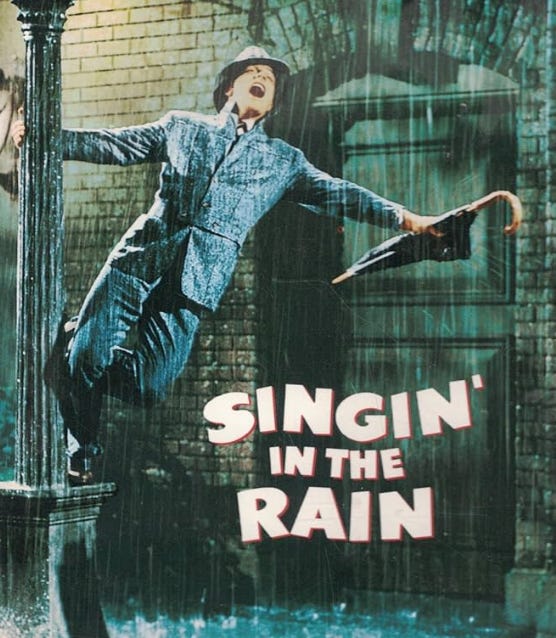
My topic today: How to deal with life’s tragedies and setbacks.
Which is kind of a big subject, so I’m going to narrow the focus just a bit and write about: Things I learned from classic Hollywood musicals about the upside of rainstorms!
For the past few months, I’ve been watching Hollywood musicals with my mom, and I’ve seen not one, not two, but THREE songs about the benefits of rainy days.
Each of these soggy tunes offers a different approach to dealing with tragedy – and they are three strategies that, to a greater or lesser degree, I find helpful. Here’s the breakdown:
Song #1: “SINGIN’ IN THE RAIN”
This tune (from the movie of the same name) is the most famous of the pro-precipitation songs -- the Beyoncé or Alvin of the trio.
You’ve probably seen Gene Kelly tap-dancing through puddles and cozying up to a lamppost as he belts out…
“I’m laughing at clouds
So dark up above
The sun’s in my heart and
I’m ready for love.”
The point here, of course, is that our mental well-being should not be overly reliant on external events.
It’s some good wisdom, with Stoic and Buddhist overtones.
It’s also wisdom that’s hard to follow. I struggle with it every day. I hate how much a minor setback – a rude email or a lower-than-expected number of downloads on my podcast - can send me spiraling. I wish my emotions were more of a sturdy tree trunk and less of a wispy reed flapping in the wind. I wish I had a brighter sun in my heart.
I have various strategies for attempting to bulk up my emotional resilience. First, there are the gratitude practices I’ve talked about in several previous columns (e.g., reminding myself of the multitude of sunny days behind and ahead).
Another technique is to cultivate some Buddhist appreciation for the allegedly negative event. To try to splash in the puddles, as Gene Kelly does. When the airline delays my flight 7 times, I try (with varying success) to see the comic absurdity of it, the future storytelling possibilities. I call it self-Schadenfreude – joy at my own pain.
And if I can’t enjoy something, at least I can attempt to be more neutral about it, to approach it from a meditative distance. “I’m feeling that sharp December wind biting my face – isn’t that an interesting sensation!?”
One caveat: You don’t want your emotions to be totally removed from external events, because that can verge on sociopathy. Ideally, my emotional tree isn’t too rigid or too flimsy - it sways just the right amount.
Song #2: “LOVELY WEATHER FOR DUCKS”
This song is a lesson in perspective-taking. It appears in the 1953 musical The Stars are Singing. Rosemary Clooney (George’s aunt!) stars in this tale of a teenager from Poland who becomes an opera sensation, and she sings:
“When it’s pouring rain and people complain
And things aren’t worth the shucks
Don’t you yell; just say,
‘Well, it’s lovely weather for ducks.’”
The thesis here is that water-loving fowl enjoy a good rainstorm, so try to be happy for them, if not for yourself. I’d add that you don’t even have to go to the animal kingdom. Rainy days are also lovely weather for carrot farmers, reservoir management professionals, and umbrella manufacturers.
This is also a difficult mental task. It takes a highly evolved mind to appreciate that you aren’t the center of the universe.
I’ve written about my love of the concept of “sonder,” which is the realization that every stranger you pass on the street has an inner life as rich and complex as your own. (Thanks, John Koenig!) Part of sonder is realizing that what’s good for you isn’t always good for others, and vice versa.
I try this perspective-taking whenever I can. For instance, I’ve long resented Craigslist, since it was a disaster for newspapers and decimated the industry’s classified ad revenue. But maybe, I remind myself, Craigslist was overall good for society, making it easier to find jobs and used lamps. Or take composting. New York City recently started requiring composting, which is yet another annoying task in my day – but it’s probably better for my future great-grandchildren, if humans survive that long.
One note: This song might not be factually accurate about ducks and rain. According to some ornithologists, rain is not good for ducks, because it washes the protective oil off their feathers. But Rosemary’s general point is solid.
Song #3: “ISN’T THIS A LOVELY DAY?”
This Irving Berlin song is featured in the 1935 Fred Astaire-Ginger Rogers movie Top Hat. Fred’s character sings:
“The turn in the weather
Will keep us together
So I can honestly say
That as far as I’m concerned
It’s a lovely day
And everything’s okay.”
Fred, you see, has a crush on Ginger, but she’s immune to his charms. Until, that is, Fred and Ginger get caught in a rainstorm and are forced to seek shelter together in a gazebo, where, over the next three minutes, Ginger reconsiders and falls in love with Fred.
This is the classic example of reframing a bad event. Seemingly bad things can have wonderful consequences. Closed doors lead to open windows.
Reframing is a powerful tool when creating a narrative of our lives. And the blessings-in-disguise theme often does ring true. For instance, Julie’s ad-sales job at a magazine was eliminated, but that allowed her to help start a scavenger hunt company, which is celebrating its 25th successful year. (Watsonadventures.com)
I actually prefer a more agnostic spin on the blessings-in-disguise narrative. Life is so complicated, so full of twists and turns, that it’s not always clear whether a particular event will end up being overall good or bad. This strategy helps prevent me from catastrophizing when something seemingly bad happens, and from becoming irrationally exuberant when something seemingly good happens.
There’s a famous Chinese parable on this topic, which Buddhist writer Alan Watts recounted this way:
Once upon a time, there was a Chinese farmer whose horse ran away. That evening, all of his neighbors came around to commiserate. They said, “We are so sorry to hear your horse has run away. This is most unfortunate.” The farmer said, “Maybe.”
The next day the horse came back bringing seven wild horses with it, and in the evening everybody came back and said, “Oh, isn’t that lucky. What a great turn of events. You now have eight horses!” The farmer again said, “Maybe.”
The following day his son tried to break one of the horses, and while riding it, he was thrown and broke his leg. The neighbors then said, “Oh dear, that’s too bad,” and the farmer responded, “Maybe.”
The next day the conscription officers came around to conscript people into the army, and they rejected his son because he had a broken leg. Again all the neighbors came around and said, “Isn’t that great!” Again, he said, “Maybe.”
The whole process of nature is an integrated process of immense complexity, and it’s really impossible to tell whether anything that happens in it is good or bad — because you never know what will be the consequence of the misfortune; or, you never know what will be the consequences of good fortune.
This doesn’t mean I’ve given up trying to make good things happen. But it does mean that I’m a little less anti-rain. I’d love to hear from readers about your strategies for dealing with life’s rainstorms, snowstorms, hailstorms, haboobs, and any other inclement psychological weather.
Reframing is a strategy I often used in my counseling practice, and I have told the story of the Chinese farmer many times. I also like the quote attributed to Shakespeare:
“There is nothing either good or bad, but thinking makes it so” Hamlet (Act 2, Scene 2).
Change how you think, and you change everything.
That has been very difficult during this current political climate, so I try to focus on what it will be like when this hell is over. Make plans. Dream dreams. Look for anything I can to appreciate in there here and now.
My choice of perception is- whatever comes my way, let me bow. Even and especially when I cant bow.